
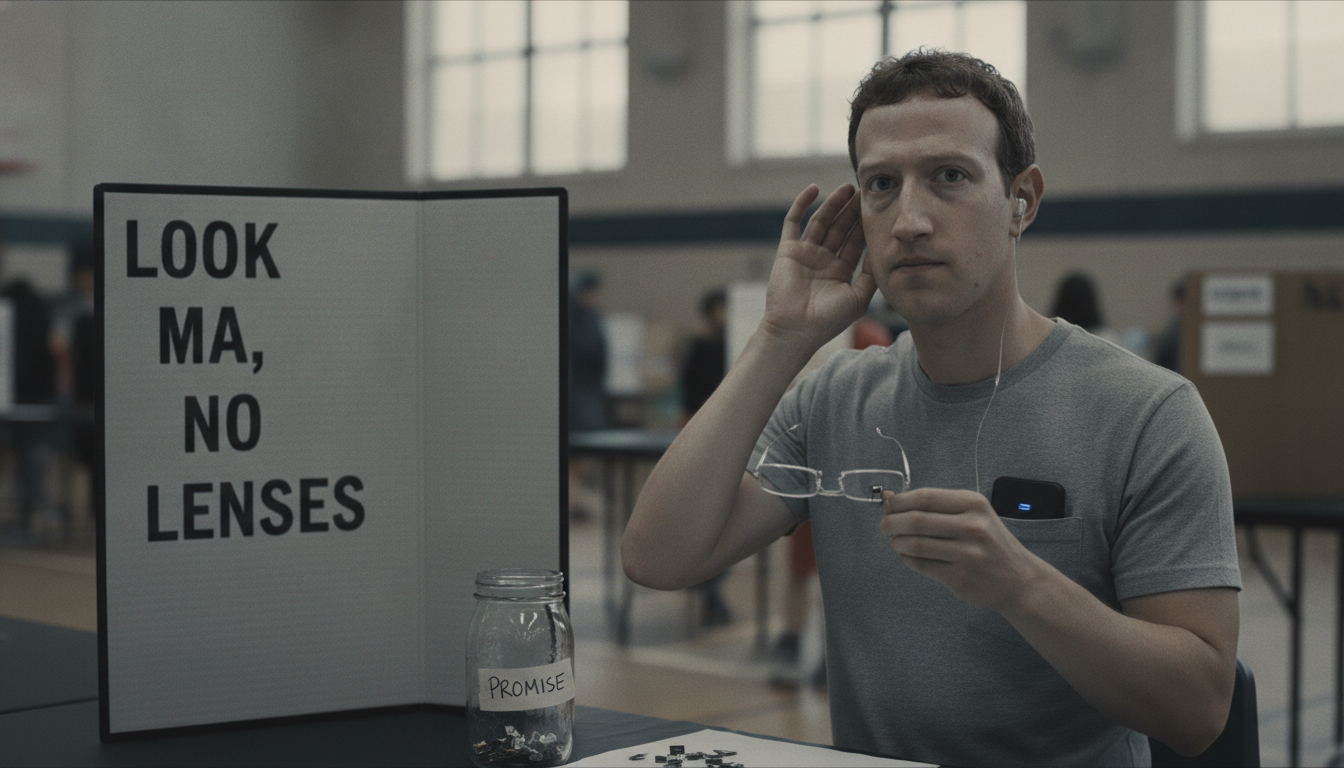
Mark Zuckerberg is staring down the barrel of another massive hardware gamble, and this time, the stakes are entirely different. We aren’t talking about legless avatars floating around in a barren digital wasteland anymore. We are talking about the real world, real privacy, and real billions on the line. Meta Connect 2026 is here, and the whispers leaking out of Menlo Park are painting a picture of a company desperately trying to balance cutting-edge ambition with a glaring, public relations nightmare.
The numbers do not lie, and neither does the public backlash. For months, Meta has been under intense, unforgiving scrutiny. Why? Because people have been using their flagship smart glasses to covertly record strangers in public. It is the ultimate tech faux pas, a privacy disaster that makes the old Google Glass era look like a minor misunderstanding. Now, Zuck and his executive team are being forced to pivot, and they are doing it live on stage in front of the entire world.
If you are operating in the tech space, or frankly any industry where consumer trust intersects with daily operations, you need to pay attention to what happens at 7 PM ET on September 23rd. This is not just a standard product launch with some flashy lights and a rehearsed keynote. It is a masterclass in crisis management, rapid product iteration, and the relentless, unapologetic pursuit of wearable dominance.
Look, you do not drop billions of dollars into a hardware division just to walk away when the public gets a little spooked. You adapt. You evolve. You find the angle.
The Creep Factor And The Camera-Free Pivot
Let us get straight to the drama. The biggest, juiciest announcement expected at Meta Connect isn’t a groundbreaking new feature; it is the complete removal of one. Meta is reportedly ditching the camera on its newest pair of smart glasses.
Read that again. A tech giant historically known for harvesting every conceivable data point is stripping the visual lens right off its flagship wearable.
Why? Because the market demanded it, and the legal liabilities were piling up. The covert recording scandal was becoming a massive, undeniable anchor around the neck of their hardware division. You simply cannot build the future of computing if every time someone walks into a coffee shop wearing your product, the barista thinks they are being secretly filmed for a viral social media stunt. It is bad for business, it is toxic for the brand, and frankly, it is just creepy. People have boundaries. You have to respect the end-user, or the end-user will bankrupt your hardware dreams.
The removal of the camera is not a technological step backward; it is a calculated, ruthless survival tactic designed to keep wearable technology on the faces of everyday consumers without triggering a massive privacy revolt.
This is where the tough love comes in for any operator watching this unfold. You can engineer the most brilliant, seamless piece of technology on the planet, but if it makes the general public uncomfortable, it will die on the vine. Meta realized that the friction of social unacceptability was going to throttle their adoption rates permanently. So, they swallowed their pride, looked at the cold hard data, and made the difficult call.
A camera-free pair of smart glasses shifts the focus entirely away from capturing the outside world, and places it squarely on augmenting the user’s internal reality through audio and intelligence. It is a brilliant, necessary pivot. By removing the lens, they remove the threat. And by removing the threat, they open the door for their real Trojan horse.
Enter Muse: The Standalone AI Gadget Play
If the camera is gone, what is left to sell? The intelligence. The source leaks are pointing heavily toward a massive, sweeping integration of something called Muse AI. And this is not just a background software update meant to fix a few bugs. Meta is reportedly making a standalone Muse AI gadget, while simultaneously integrating Muse directly into the new smart glasses.
This is the play. This is the heavyweight bout between innovation and public perception.
Meta is making Muse significantly more powerful, and the rumors suggest they will even let you video chat with it. Imagine the sheer operational leverage of having an autonomous assistant literally whispering in your ear, processing your environment, and handling your communications without you ever having to pull a glass rectangle out of your pocket. They are trying to build the ultimate frictionless interface, and they are betting the farm that Muse is the key to unlocking it.
But let us not pretend this is going to be a walk in the park. Meta has a long, documented history of launching ambitious hardware projects that fizzle out when they hit the harsh reality of consumer habits. Remember the Portal? Exactly. But Muse feels fundamentally different. By embedding it into wearables and creating standalone gadgets, Meta is betting that artificial intelligence does not need a traditional screen to be indispensable. It just needs to be present, reliable, and invisible.
When you strip away the novelty of the hardware, the real battleground for the next decade of tech is the invisible layer of artificial intelligence that dictates how we interact with our daily operations.
For business owners, executives, and operators, the implications here are staggering. We are rapidly moving toward a world where your clients, your competitors, and your team are interacting with autonomous agents seamlessly throughout the day. If Meta gets this right, the smart glasses become nothing more than a delivery mechanism for Muse. The hardware is just the vessel. The intelligence is the actual product.
They are giving you the tools to stop staring at a screen and start engaging with the world, all while a hyper-intelligent system manages the heavy lifting in the background. It is a bold vision, but it requires flawless execution.
The Death Of The Headset And The Rise Of The Glasses
Let us talk about the elephant in the room: Virtual Reality. Meta Connect has traditionally been the holy grail for VR enthusiasts, the annual venue where the company shows off its latest bulky headset and promises us that the immersive metaverse is just around the corner.
Not this year. The ambitions have scaled back. The reality check has finally cleared the bank.
The leaks are loud, clear, and undeniable: Meta’s next VR device isn’t a headset—it is glasses. A recent leak seemingly revealed unannounced mixed reality glasses, indicating a massive, fundamental shift in form factor. People do not want to strap a one-pound plastic brick to their face to check their emails, attend a virtual meeting, or watch a movie. They want sleek. They want lightweight. They want to look normal while they work.
Sure, there are still a few updates being tossed to the legacy users. Soon, you will be able to rent or buy movies right on your Quest headset. That is a nice little feature for the die-hards who still enjoy the isolation of a full VR setup. But let us be brutally honest: the writing is on the wall. The clunky VR headset is going the way of the dinosaur, making room for sleek, mixed-reality glasses that blend the digital and physical worlds without completely isolating the user from their environment.
The transition from isolating headsets to integrated smart glasses marks the exact moment the tech industry realized that human beings actually want to remain connected to the physical world while they operate.
Mark Zuckerberg is taking a massive swing here. He is pivoting away from the creepy camera features that got his company in hot water, doubling down on the Muse AI integration to power the next generation of wearables, and shrinking the grand VR dream down into a pair of glasses you can actually wear in public without looking ridiculous.
It is a high-stakes game of hardware roulette, and the entire industry is watching closely to see where the ball lands. Will it work? That depends entirely on whether they can deliver on the promise of Muse without tripping over another privacy landmine. But you have to respect the hustle. They saw the backlash, they saw the hardware fatigue, and instead of stubbornly doubling down on a losing hand, they changed the game entirely. That is how you survive in this space. You adapt, you iterate, and you never stop pushing the boundaries of what your systems can handle.
If you want to learn how to build that kind of ruthless, autonomous efficiency into your own business operations, let’s talk.